By Libby and Robert Strong
As the hot, sticky, hazy days of summer come to a close, everybody
enjoys a late summer picnic. When we are camping or just having a
simple lunch outdoors, we are always reminded to place unused food back
into the cooler or refrigerator. Did you ever wonder why do we do
this? Have you ever wondered what would happen to the food if you
just left it out? When parents ask us to help put away the food after
a meal, this request is even more important than turning off the lights
when you leave a room or closing the door to an air conditioned room when
you exit. Saving energy is good for the planet and helps to save
money.
Lowering the temperature of food you are saving for a later
snack is important to your health and the health of your family.
But why is this so?
The following two experiments will help you to get a deeper understanding
of how changes in temperature work to change the speed of biological growth
or how fast some chemical reactions progress.
Temperature and Yeast
Try this experiment to find the temperature “preferred” by yeast, a simple one-celled organism (actually a fungus) that uses sugar as an energy source. Yeasts can’t make their own food like plants can. Yeasts don’t really “eat”, either. Yeasts actually absorb the raw materials they need to live, grow, and reproduce from their surroundings. The following is a list of materials you will need:
A: Permission from your parents. Parents have all kinds of good ideas and insights into science related stuff. Remember, once long ago, they were kids just like you. Give your parents the chance to relive some of the sense of wonder, excitement, and discovery of science through your sharing this experiment with them.
B: Three packets of powdered yeast (found in the baking aisle of your local grocery store)
C: Three empty 20 ounce (591 ml) plastic drink bottles, rinsed out to keep the stickiness out of the experiment
D: Three large balloons that will fit completely over the mouth of the 20 ounce plastic drinking bottles
E: Three teaspoons of sugar
F: A teaspoon
G: Measuring cup (254 ml) for pouring warm water
H: Access to warm water from your kitchen tap (feel the water -- it should not feel “HOT”)
Find three dark places that have different temperatures. Three suggestions are: 1) inside your refrigerator (not the freezer), 2) a kitchen cabinet (room temperature), and 3) in your attic or un-air conditioned upper floor of your home where it is the warmest.
Open each packet of powdered yeast and empty each into a separate
20 ounce plastic drinking bottle. Add a teaspoon of sugar to
the powdered yeast in each bottle.
Fill each bottle with warm water about half full (about one
cup). Squeeze all the air out of your three balloons and place
them completely over the bottle openings and over the lowest ring lip of
the bottle openings.
Observe each bottle each day for three to four days.
Notice the size of the balloons.
Do the balloon sizes differ? Why?
What is going on? And what is in the balloons?
How can we tell that yeasts are organisms (living things)?
To find out more, log into www.smartcenter.org/OVPM/Yeast
Temperature and Glow Sticks
One of the all-time favorite fun filled summer pastimes is catching fireflies (AKA lightning bugs). Around mid summer these delightful and completely harmless beetles come out just after dusk looking for a mate. The following “easy-glow” experiment will show how temperature will change the speed of the chemical reaction within a glow stick. The following list of materials is needed for this experiment:
A: Three identical glow sticks
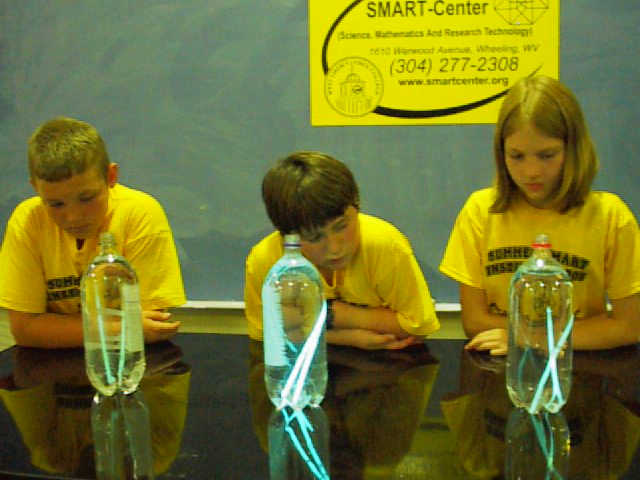
B: Three two-liter soda bottles (clear plastic works best)
C: Three strings each 12 inches (30 cm) long
D: Access to ice water, room temperature water, and hot water (from the tap)
E: Measuring cup (254 ml) for pouring water
Tie the strings around the end of each of the glow sticks.
Fill each of the two-liter bottles to 2/3 full. Fill one bottle
with ice water, the second bottle with room temperature water, and the
third bottle with hot water (label them or have your parents help keep
track of which is which). Activate each of the glow sticks
- bend, crack, shake and wait for a count of 10 for them to fully glow.
Predict what will happen to the brightness of each glow stick before placing
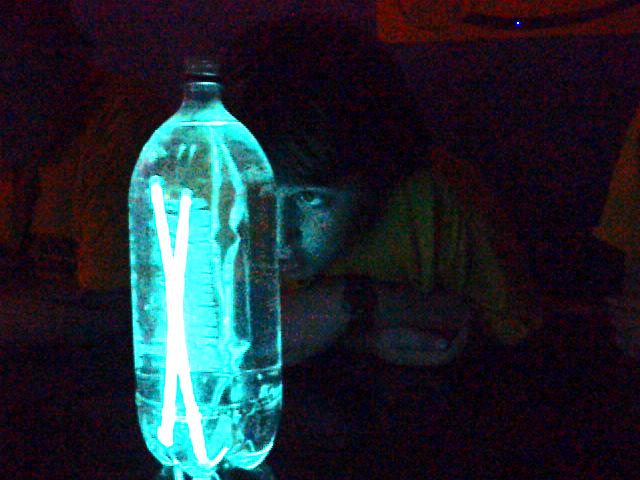
them into the different temperatures of water. Dim the light
in the room. Lower a single glow stick into each two-liter
bottle and observe what happens. What is going on?
Which temperature water made the glow stick glow the brightest?
How can you save your glow stick for later? To find out more
about fireflies and glow sticks visit us at
www.smartcenter.org/OVPM/Fireflies&GlowSticks
What’s Up?
As the summer continues we notice shorter days, which means longer, cooler nights ahead. These are the perfect conditions for stargazing. Arrange with your family to go out on a clear evening and as a family watch a meteor shower. As a special family treat, attend one of the free astronomy sky events held at Brooke Hills Park this summer and fall. Members of the local astronomy club ASTROLABE, the Near Earth Object Foundation, and staff of the WLSC SMART-Center bring their telescopes to the park for evening events with the public. For more information on upcoming free astronomy events at Brooke Hills Park visit our website: www.smartcenter.org/Whatsup
Libby and Robert Strong work at the West Liberty State College SMART-Center.
Libby is the director of the West Virginia Handle On Science Program that
brings hands-on science kits into the classrooms of K-6 grade public schools
in the five counties of West Virginia’s Northern Panhandle.
Robert is the Director of the WLSC SMART-Center, the hands-on science center
of northern West Virginia. Libby and Robert invite you to visit
the SMART-Center website at www.smartcenter.org