Fun Cloud Activities!
A Look at Shapes in Clouds
Have you ever looked at clouds that looked like jumping poodles, people that you know, or even the head of a dragon? Your imagination may turn the clouds you see into hundreds of different objects and faces as you spend time gazing into the sky and watching the clouds roll by. Lying in the grass looking straight up is a great way to see many different cloud shapes. The best time to look for shapes in clouds is a on a breezy day with scattered clouds.
For this cloud activity you will need:
A: A partly clear day with clouds
B: Your imagination
C: A blanket to lie on (note: lie down in the shade of a tree and put on sunscreen)
D: A partner to help observe your cloud and tell you what they see in the clouds
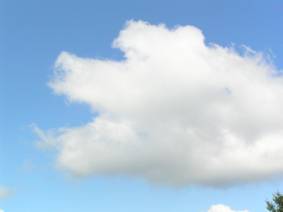
Does this cloud look like the head of a dragon to you?
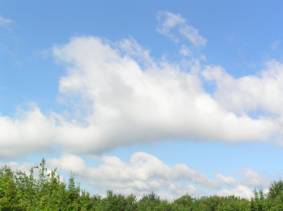
How about this cloud? Could it really be a jumping poodle?
How many different shapes can you and your imagination see? You may want to start a Cloud Discovery Journal. This is a great way to draw, record, and describe and what you see and even classify the types of clouds.
Kinds of Clouds
Looking at clouds is one way to find out about the weather. Some clouds are fluffy; some are like feathers. Sometimes clouds are not white, but are dark. Notice what clouds look like before it rains. Do clouds on a fair day look different from rain clouds?
A friend of ours, Dr. Tina Cartwright, the West Virginia Climatologist, has developed a Cloud Identification Guide. Download Dr. Cartwright’s Cloud ID Guide and take it outside to find out which kinds of clouds are in your sky on any given day. You can find her Cloud ID Guide at http://www.wvclimate.org/documents/cloud/CloudID.pdf
Other family oriented
science related activities co-sponsored by the SMART-Center
ASTROLABE Astronomy Club:
(12 part series “The Solar System Inside and Out”)
ASTROLABE Astronomy Club meets on the third Wednesday evening of each month at 7:00 p.m. on the Second floor of the Warwood Center at 1610 Warwood Avenue, Wheeling. The ASTROLABE Astronomy Club has met for over 8 years at the present location and is Free to the public. Snacks and refreshments are provided.
ASTROLABE Astronomy Club will host the 12 part monthly series “The Solar System Inside and Out” which premiered May 17, 2006 with “The Sun Our Star”. Presenters for “The Solar System Inside Out” series will be from WLSC SMART-Center staff and will offer hands-on activities appropriate for all age groups. The 12 part series is sponsored in part by the NASA West Virginia Space Grant Consortium. After the ASTROLABE Club meeting, if the sky is clear, the ASROLABE members will have a free public StarWatch in front of the Warwood Center.
Radio Science News
If you want to learn more about science, you can tune into “Radio Science News” on WVLY 1370 AM, Saturday mornings from 11:00 a.m. to noon. “Radio Science News” immediately follows the two-hour nature program, “The Wild Side”, hosted by the regional naturalist Dr. Scott Shalaway. Robert E. Strong and Richard Pollack co-host “Radio Science News”, a local radio call-in program with a science theme.
Science in Science Fiction
Club:
The “Science in Science Fiction Club” meets on the second Wednesday evening of each month at 6:00 p.m. on the Second floor of the Warwood Center at 1610 Warwood Avenue, Wheeling. Free to the public, snacks and refreshments are provided as we watch and discuss the science in science fiction movies. Check the website www.smartcenter.org for movie titles and information.
What’s Up? Free Monthly StarWatches at
Brooke Hills Park:
Free public StarWatches every third Friday evening of each month at 8:00 p.m.. StarWatches will take place at Brooke Hills Park’s Cardinal Shelter. Members of the ASTROLABE Astronomy Club, staff of the WLSC SMART-Center, and the Near Earth Object Foundation will co-present these Free public StarWatches.
Telescopes will be provided to view the evening sky and the public is invited to bring their telescopes to the StarWatch events. If the weather does not permit outdoor telescope viewing, the co-presenters will give an astronomy related interactive presentation for the whole family. The StarWatches are sponsored in part by the NASA West Virginia Space Grant Consortium. Please visit www.smartcenter.org/whatsup/ for up-to-date listing of astronomy and other events.
Brooke Hills Park Astronomy
Weekend:
On September 22 through 24 Brooke Hills Park, West Virginia’s first Dark Park and Dark Sky Preserve, will host an Astronomy Weekend. The BHP Astronomy Weekend is designed for the beginner and the advanced amateur astronomer and is a family-friendy Astronomy Weekend. For more information visit the website
http://www.smartcenter.org/BHPAstroWeekend.html
Libby and Robert Strong and Richard Pollack work at the West Liberty State College SMART-Center. Libby is the director of the West Virginia Handle On Science Program that brings hands-on science kits into the classrooms of K-6 grade public schools in the five counties of West Virginia’s Northern Panhandle. Robert is the director of the WLSC SMART-Center, the hands-on science center of northern West Virginia. Richard serves as the WLSC SMART-Center Assistant Program Coordinator. Libby, Robert, and Richard invite you to visit the SMART-Center website at www.smartcenter.org