February Food For Thought
February is usually a cold month but that doesn’t mean there is nothing to do. One single day event in February is Valentine’s Day. The entire month of February is Black History Month. This is the annual celebration of the contributions of African Americans to the history of the United States.
Black History Month started eighty years ago. It’s founder, Dr. Carter G. Woodson chose February as the month for this celebration because Abraham Lincoln, our twelfth president and Frederick Douglass, an African American educator and scholar, were born near the middle of February. Take some time to check out our web site links to some of our favorite Black History Month scientists and inventors at www.smartcenter.org/BlackHistoryScience.html
One of the most famous inventors and scientists to be born in North America is the African American George Washington Carver. Dr. Carver is best known for discovering over 300 uses for the peanut as well as inventing the process for turning oil into solid shortening. This process is called hydrogenation. This solved the problem of peanut butter separation. Dr. Carver did not invent peanut butter as is often thought. He perfected it. Dr. Carver also studied many living things in nature. Carver once told his adoptive mother that he wanted to know all there was to know about everything. Knowing everything is a big goal, but Dr. Carver said he “wanted to know every strange stone, flower, insect, bird, or beast”. Dr. Carver learned very much in his lifetime and our lives are better because of his discoveries and inventions. Even now, over 60 years after his death, his work in alternative fuels is meaningful now and will improve our lives far into the future.
If you want to learn more about Dr. Carver, check out the George Washington Carver Coloring and Activity Book at http://www.usda.gov/oo/colorbook.htm
This month’s activity is designed to honor Dr. Carver as a naturalist. A naturalist is a person who is interested in all the wonders of the natural world. You can build a simple device that will help feed some of our feathered friends throughout the rest of the winter.
For this activity, we will use either peanut butter (remember, Dr. Carver invented a way to keep the oil from separating in peanut butter) or shortening (oil that has been made solid – another of Dr. Carver’s many inventions).
Pine Cone Bird Feeder
For this activity you will need:
1) a large pine cone
2) peanut butter and/or shortening
3) bird seed
4) yarn or string of length 50 cm (about 20 inches)
5) plate
6) spoon or popsicle stick
7) newspaper
8) tree or location to hang finished bird feeder (where you can see it from a window in your house or school)
Safety Note: Use shortening if you or anyone helping you has a peanut allergy. Shortening or lard is a good substitute for peanut butter according to our friend and naturalist Dr. Scott Shalaway.
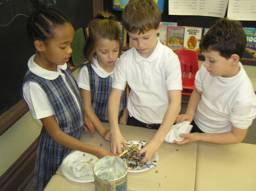
L to R, Jaela Manns, MacKenzie Treiber, Tyler Riedel, and Michael Miller, 2nd Graders at Corpus Christi making a pine cone feeder.
Activity Steps:
Step 1) Spread newspapers over workplace. This is much easier to clean-up when you are done. You can put this directly into your compost.
Step 2) Place a pine cone on the plate and tie a piece of yarn or string securely around the pine cone. The yarn will be used to hang the pine cone feeder from a tree branch or other observation spot.
Step 3) Try to keep the peanut butter away from the string (or will be real messy later while hanging). Spread the peanut butter well into all the spaces of the pine cone with the spoon or popsicle stick.
Step 4) Spread peanut butter over the surface of the pine cone.
Step 5) Place 2 cm (3/4 inch) of bird seed on the plate and carefully roll the peanut butter coated pine cone in the bird seed until completely covered.
Step 6) Take the pine cone feeder by the string and carry it outside to hang up.
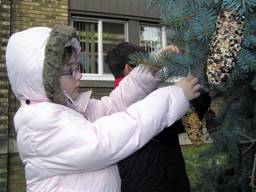
Katie Holt, 2nd Grader at Corpus Christi School
hanging a pine cone feeder.
Watch
your pine cone bird feeder to see if the birds like to snack on it. You can watch from your window. What kinds of birds come to your
feeder? If you want , you can
experiment and compare peanut butter and shortening bird feeders. Do birds prefer “Crunchy” or “Smooth”?
Check out our website for helping
with Bird Identification at
www.smartcenter.org/ovpm/BirdID
Other family oriented science related activities
co-sponsored by the SMART-Center
12 part series “The Solar System Inside and Out”
ASTROLABE Astronomy Club meets on
the third Wednesday evening of each month at 7:00 p.m. on the Second floor of
the Warwood Center at 1610 Warwood Avenue, Wheeling and will host the 12 part
monthly series “The Solar System Inside and Out”. The topic for February 21, 2007 is Saturn, the Ringed Planet and is the ninth part in this the series. The Saturn program will offer hands-on
activities appropriate for all age groups. Snacks and refreshments are
provided. The series is sponsored
in part by the NASA West Virginia Space Grant Consortium. After the meeting, if the sky is clear,
a free public StarWatch will be held in front of the Warwood Center.
Radio Science News
If you want to learn more about
science, you can tune into “Radio Science News” on WVLY 1370 AM, Saturday
mornings from 11:00 a.m. to noon.
“Radio Science News” immediately follows the two-hour nature program,
“The Wild Side”, hosted by the regional naturalist Dr. Scott Shalaway. Robert E. Strong and Richard Pollack
co-host “Radio Science News”, a local radio call-in program with a science
theme. Check the website http://neofoundation.org/radiosciencenews/ for current topics
and information.
Science in Science Fiction Club, February 14:
The “Science in Science Fiction
Club” meets on the second Wednesday evening of each month at 6:00 p.m. on the
Second floor of the Warwood Center at 1610 Warwood Avenue, Wheeling. Free to the public, snacks and
refreshments are provided as we watch and discuss the science in science
fiction movies. Check the
website www.smartcenter.org for movie titles and information.
What’s Up?
Free Monthly StarWatches at Brooke Hills Park, February 16:
Free public StarWatches every third Friday evening
of each month at 8:00 p.m. at Brooke Hills Park’s Clubhouse will be led by
members of the ASTROLABE Astronomy Club, staff of the WLSC SMART-Center, and
the Near Earth Object Foundation.
Telescopes will be provided, and
the public is also invited to bring their telescopes to the StarWatch
events. If the weather does not
permit outdoor telescope viewing, the co-presenters will give an astronomy
related interactive presentation for the whole family. The StarWatches are sponsored in part
by the NASA West Virginia Space Grant Consortium. Please visit www.smartcenter.org/whatsup/ for up-to-date
listing of astronomy and other events.
Libby and Robert Strong and Richard Pollack work at
the West Liberty State College SMART-Center and invite you to visit the
SMART-Center website at www.smartcenter.org