SMART Science
January/February 2009
Adventures on Ice
If the weather outside is “frightful”, you and your family can still have some winter fun. Ice-skating and sled riding are two winter activities that use the special properties of ice and snow for sliding around when the temperature is low.
Controlled sliding can be very fun. It is exciting to slide down a snow covered slope in your backyard on a sled with your brother, sister, or friend. Any snow covered hill is good for sled riding as long as there aren’t any trees, big rocks, or other objects to run into and it is far from any street or road. Always ask your parents before you go sled riding. They will tell you if the spot you have chosen is safe. They may want to come with you!
Ice-skating is a beautiful and elegant sport that also uses the slippery properties of the ice. Ice skating rinks such as the one at Wheeling Park are good places to ice skate. Some people skate in beautiful performances such as the Symphony on Ice.
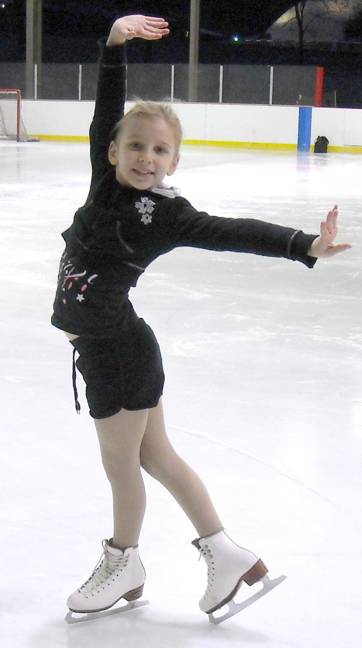
Katie Angius, (daughter of John and Karin Angius) third grader at Corpus Christi School in Wheeling and member of the Wheeling Figure Skating Club.
Have you ever wondered why we slide on ice-covered surfaces? Try this experiment to test different surfaces and how each affects the motion of a marble.
You will need:
1) Two rulers
2) Meter stick (a yard stick will be ok, but remember that scientists use metric!)
3) One marble
4) Thick book (at least 3-4 centimeters thick)
5) Waxed paper
6) Several sheets of sandpaper
7) Aluminum foil
8) Large bath towel
9) Space on the floor or a large table
10) Paper and pencil to record your data
Before you start the experiment, guess on which surface the marble will roll the furthest (waxed paper, sand paper, aluminum foil, or bath towel). Why do you think so?
Here is what you will need to do:
1) Place the two rulers close together just off the edge of the thick book to make a ramp for the marble.
2) Place a length of waxed paper at the end of the ramp (you will need 50cm to 1 m of waxed paper).
3) Release the marble. Don’t push it! The ramp will be just the amount of push it needs to start rolling naturally downhill.
4) Notice where the marble stops and measure from the end of the ramp to where it stopped in centimeters.
5) Record this information on your paper.
6) Repeat the experiment three or more times with each surface (waxed paper, sand paper, aluminum foil, and bath towel).
7) Ask an adult to help you average your distances for each of the surfaces.
8) Compare the distances that the marble rolls on each surface.
9) On which surface or surfaces did the marble roll the furthest? On which surface or surfaces did the marble not roll very far?
(This experiment is modified from The Best of Wonder Science, 1997)
Were your predictions correct? Even if you guessed incorrectly, what did the actual results have in common with ice-skating and sled riding?
A force called friction opposes motion between two surfaces. More friction makes an object harder to move, less friction makes it easier to move. Sometimes we want to slide more (like sled riding) and sometimes we want to slide less (like on an icy highway). Do you know of materials that are placed on top of ice and snow to increase friction? In your driveway at home your parents may put cinders, sand, or even kitty litter on the driveway to help increase the friction between the tires and the driveway. The surface would then be more like the surface where the marble traveled a shorter distance when it rolled off the ramp. Without the added friction, the surface would be more like a surface where the marble rolled a long way. For more information about friction visit www.smartcenter.org/ovpm/friction
If you do want to slide, you want to reduce friction. Ice and snow certainly help to reduce friction and make ice-skating and sled riding possible and tons of winter fun!
Robert E. Strong is the director of the West Liberty
State College SMART-Center, the hands-on science center of the Northern Ohio
Valley. Libby Strong is the
Program Coordinator at the West Liberty State College SMART-Center and also
directs the WV-Handle On Science Program that brings hands-on science kits to
the public school classrooms of the Northern Panhandle. Richard Pollack is the assistant
program coordinator, webmaster, and technology specialist for the WLSC
SMART-Center. Robert, Libby, and
Richard invite you to visit the website at www.smartcenter.org