Have Seeds - Will Travel
Do plants move from place to place like animals do? Even though the parent plant doesn’t move, many of the seeds are “made to move”. Some seeds can float on the breeze like a dandelion’s seeds. Have you ever “helped” the seeds to move by blowing on a dandelion? You should be sure you don’t blow these seeds into your yard. Sometimes parents don’t like a lawn full of dandelions.
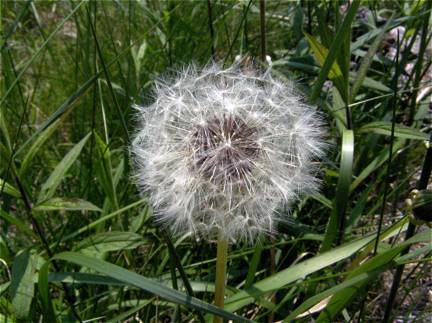
Can you think of other seeds that are carried by the wind? Why would it benefit a plant if its seeds could fly? Think of other ways that seeds could be transported from place to place. See if you can find examples of these as you are playing outside this summer.
One other way seeds can travel besides wind is when we move them. A fun and enjoyable way we at the SMART-Center move seeds is to turn them into “rockets”.
English Plantain “Rocket”:
To make an English Plantain “Rocket”, you will need:
1) A long stemmed plant with a long flower portion (English Plantain works great).
2) A friend or brother or sister.
3) Pick the plant stem close to the ground so you have lots of stem to work with.
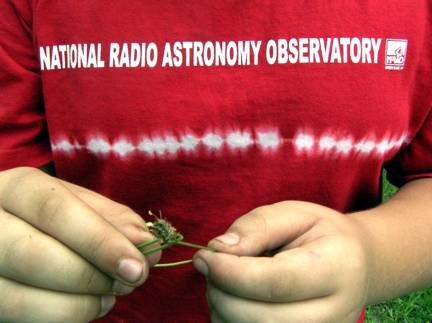
4) Wrap the end of the stem around the top of the stem just before you reach the flowering / bloom or seed part (see picture).
5) Pull the wrapped portion back gently and then move it quickly forward.
The bloom should “pop” off like a “rocket”. You will have to practice this to get real good at this and to get your aiming right. When you “pop” off your “rocket”, you may be helping the seeds to travel. If you do not want more of these seeds to grow, avoid making and launching the “rockets” whenever flower heads have made seeds.
Whirlybirds or Helicopters:
Another
experiment you can do with a different way that seeds travel is by playing with
maple tree seeds. Maple seeds have
a sort of wing on one side that causes them to spin as they slowly fall to the
ground. Look closely at this one
sided wing coming out of the maple seed.
This special type of seed is called a “samara”. The
samara flies like a “whirlybird” or “helicopter” and travels far away from the
parent tree as it spins to the ground carried by the wind.
To
watch a maple “helicopter”, toss it into the air and watch it spin as it slowly
falls downwind. What do you think
makes the maple “helicopter” seeds spin?
Do all maple “helicopter” seeds spin in the same direction?
Other
ways seeds travel include floating on water and being carried by streams and
rivers downstream. Some seeds
travel by being eaten by animals and are left in another place surrounded by
natural fertilizer (think about it).
Sometimes seeds will get stuck to your clothing or in animal fur (think
about it - where do you think the idea for Velcro came from?) and fall off or
be pulled off in another location.
How would these seed spreading strategies help the plant population?
Fort
more information about how seeds will travel visit our website at www.smartcenter.org/OVPM/seeds
Other family oriented science related activities
co-sponsored by the SMART-Center
Radio Science News
If you want to learn more about
science, you can tune into “Radio Science News” on WVLY 1370 AM, Saturday mornings
from 11:05 a.m. to noon. “Radio
Science News” immediately follows the two-hour nature program, “The Wild Side”,
hosted by the regional naturalist Dr. Scott Shalaway. Robert E. Strong and Richard Pollack co-host “Radio Science
News”, a local radio call-in program with a science theme. Check the website http://neofoundation.org/radiosciencenews/ for current topics
and information.
Science in Science Fiction Club, July 11:
The “Science in Science Fiction
Club” meets on the second Wednesday evening of each month at 6:00 p.m. on the
Second floor of the Warwood Center at 1610 Warwood Avenue, Wheeling. Free to the public, snacks and refreshments
are provided as we watch and discuss the science in science fiction
movies. Check the website www.smartcenter.org for movie titles and information.
What’s Up?
Free Monthly StarWatches at Brooke Hills Park, July 20:
Free public StarWatches every third Friday evening
of each month at 8:00 p.m. at Brooke Hills Park’s Cardinal Shelter will be led
by members of the ASTROLABE Astronomy Club, staff of the WLSC SMART-Center, and
the Near Earth Object Foundation.
The ASTROLABE Astronomy Club will also have it’s informal monthly “no
business” meeting at the StarWatch.
Telescopes will be provided, and
the public is also invited to bring their telescopes to the StarWatch
events. If the weather does not
permit outdoor telescope viewing, the co-presenters will give an astronomy
related interactive presentation for the whole family. Please visit www.smartcenter.org/whatsup/ for up-to-date
listing of astronomy and other events.
WLSC SMART-Center Summer Camps:
Fun
With Physics Camp: students entering
grades 2-7, July 12 and 13, 8:30 a.m. to 4:00 p.m., cost $60 with snacks and
lunch provided with the fee. Grade
level activities in a variety of physics concepts will be explored. Interact with the SMART-Center’s
hands-on exhibits and build a physics toy. New activities this year!
Middle
School Girls Camp: for girls entering
grades 5-8, July 19 and 20, 8:30 a.m. to 4:00 p.m., cost $60 with snacks and
lunch provided with the fee. Learn
and have fun at the same time with other girls who love science. Join an all female staff with
activities and experiments in many areas of science.
Nanotechnology
Camp: students entering grades 6-8, August
13 and 14, 8:30 a.m. to 4:00 p.m., cost $60 with snacks and lunch provided with
the fee. Grade level activities in
the area of nanoscale science and engineering will introduce this exciting
field to young scientists. Activities
will include modeling the nanoscale, molecule building, atomic force microscope
simulation, nanofibers, nanotubes, and more. This will be a repeat of last year’s successful camp.
Moon
and Mars Camp: students entering grades
3-7, August 16 and 17, 1:00 p.m. to 9:30 p.m., cost $60 with snacks and supper
provided with the fee. A variety
of space science activities will make this outdoor experience a great one for
any student. Rocket building,
gravity simulation, and planet activities will be only part of the fun filled
activities. The afternoon through
evening camp will take place at Brooke Hills Park near Wellsburg and conclude
each evening with a family StarWatch.
View the Moon, Jupiter and it’s moons, and more through telescopes
provided.
For
more information on WLSC SMART-Center Summer Camps visit and printable
applications visit www.smartcenter.org/summercamps07.html
Libby and Robert Strong and Richard Pollack work at
the West Liberty State College SMART-Center and invite you to visit the
SMART-Center website at www.smartcenter.org