SMART Science
By Libby and Robert Strong and Richard Pollack
Sometimes winter seems so long, but spring always comes around!
Here in the Northern Hemisphere we will experience the first day of
spring, the Vernal Equinox on March 20. What does the word
“Equinox” mean and what does it have to do with spring?
Modeling the Seasons
When you ask people why it is warm in July and cold in January here in
the Northern Hemisphere, many people mistakenly suppose this
temperature difference has to do with a distance change between the
Earth and the Sun during the annual journey of the Earth around the
Sun. Logically you may suppose that the Earth in wintertime would
be further away from the Sun in it’s orbit and closer in summer.
Believe it or not, the seasons aren’t caused by the Earth’s distance
from the Sun at all. Earth is actually closer to the Sun in
January than in July. The tilt of the Earth’s axis makes the
difference.
Try this activity adapted from the book Sunshine Makes the Seasons
by Franklyn Branley.
The following is a list of the materials you will need:
Marking pen
Orange
Pushpin
Pencil
Flashlight
Access to a dark room
Friend / family member to help you (this is your lab partner)
Paper towels (you might get messy)
Experimental Procedure:
Step 1: Carefully push a pencil through the orange from top to
bottom (get an adult to help you: hint the sharp end works easier than
the eraser end – Why?)
Step 2: Mark the top of the orange with “N” and the bottom with
“S” (what do you think “N” and “S” stand for?)
Step 3: Draw a line all the way around the orange halfway between
the “N” and “S” poles of your orange (this is the equator)
Step 4: Stick the pushpin into the orange at the spot where you
think we live (hint: you do not find wild penguins living there) a
little less than half way between the equator and the “N”.
Step 5: Slowly spin the orange around while keeping the pencil
stationary. Remember this is just a model. The Earth is not
an orange, and there is no giant 16,000-mile long pencil running
through the Earth’s axis.
Step 6: In a darkened room, aim your flashlight (turned on so it
models the Sun) toward the orange / pencil model (held by your lab
partner).
Step 7: Hold the model so that the pencil (modeling the Earth’s
axis) is straight up and down. What do you see? Slowly spin
the orange. What do you see and why?
Step 8: Now, have your lab partner walk all around you with the
axis still straight up and down while you stand in one place and keep
the flashlight aimed on the Earth model (this models the Earth orbiting
the Sun, once around equals one year).
Step 9: Next, tilt the model (about 1/3 to the side) so that the
“N” pole (have you guessed what the “N” stands for?) is away from the
flashlight. What do you observe?
Step 10: slowly spin the orange on its axis and notice how long
the pushpin is in the (Sun) light. Why does this happen?
Step 11: Keep the tilt of the Earth’s axis constant and in the
same direction and walk around the flashlight (Sun). When is it
winter and when is it summer for the pushpin? (Remember how long
the Sun is in sky during the winter and summer and you can figure it
out.)
The Vernal Equinox (for the pushpin) is that time half way between the
least amount of daylight and the greatest amount. It is the time
“Equal” in between. This year the Vernal Equinox – the time half
way between the winter and summer will happen March 20 at 1:26 p.m.
EST. To learn more about the Vernal Equinox see our website
at
http://smartcenter.org/ovpm/equinox
“Eggceptional” Equinox Urban Myth
Sometimes people get a bad idea about science (we call this a
misconception) and share it with others. Before you know it lots
of people believe something wrong to be true. One such
misconception or urban legend or myth concerning the Vernal Equinox is
that on this day, and only this day, can you balance an egg on its
end. Well, this is just silly! Try balancing an egg on its
end. It is very hard to do but you can do it with enough patience
any day of the year. If you want a little help, place a pinch of
salt on a flat table. Pile it up in a small mound and gently
place an egg on the top of the salt mound. Push softly and twist
gently. Let go and the egg may stand up. Softly blow the
salt away from under the egg and it looks like it is balanced on
end. For more information in the this egg balancing myth see our
web site at
http://smartcenter.org/ovpm/eggmyth
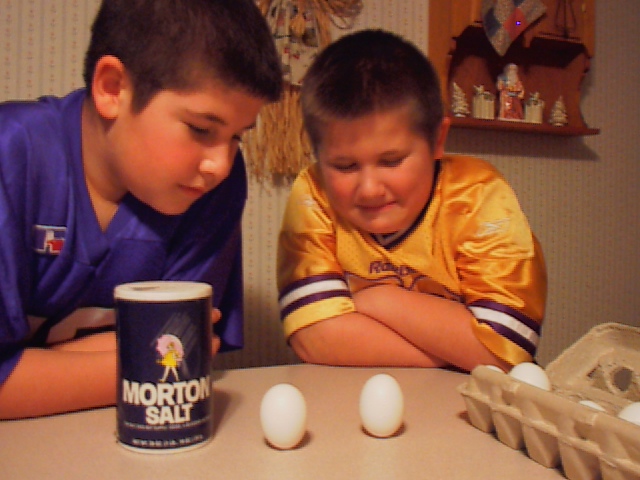
Below are two young scientists
successfully balancing an egg.
For more “eggsperiments” just in time for Easter, check us out next
month.
What’s Up? National Astronomy
Day 2006 and Pluto Poster Contest
National Astronomy Day will be celebrated this year on Saturday May 6
at Brooke Hills Park’s Cardinal Shelter. Program starts at 7:00
p.m. with safe solar observing. The National Astronomy Day
program is free to the public.
For the last 12 years the WLSC SMART-Center has sponsored a National
Astronomy Day Poster Contest open to regional Kindergarten through
Sixth grade students. The winner of the poster contest will win a
free StarWatch for their entire school. The theme this year is
“Pluto Our Ninth Planet”. See our website for rules for this
contest. For more information on upcoming free astronomy events
at Brooke Hills Park, visit our website:
http://smartcenter.org/whatsup
Libby and Robert Strong work at the West Liberty State College
SMART-Center. Libby is the director of the West Virginia Handle
On Science Program that brings hands-on science kits into the
classrooms of K-6 grade public schools in the five counties of West
Virginia’s Northern Panhandle. Robert is the Director of the WLSC
SMART-Center, the hands-on science center of northern West
Virginia. Richard serves as the Assistant Program Coordinator at
the SMART-Center. Libby, Robert, and Richard invite you to visit
the SMART-Center website at http://smartcenter.org