SMART Science
Composting:
Dinner for Your Garden
Something that many children, and adults like to do is play in the dirt. Do you know people who like to plant flowers and grow vegetable gardens?
When we prepare food for our families, we often have a lot of scraps left over that sometimes are thrown away or put into a garbage disposal. When the lawn gets mowed or leaves are raked up, what can we do with the grass clippings or all the piles of leaves? Did you know that all of these leaves, clippings and scraps could be used to make our gardens even more beautiful?
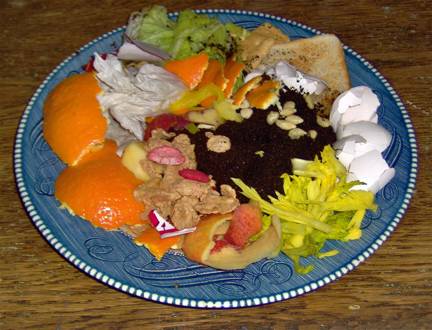
Aluminum cans and plastic milk bottles can be recycled and used to make new cans and bottles. Recycling means that instead of just throwing things away, we find ways to use them again. Composting is an important part of recycling. Did you know that a lot of materials we throw away could be recycled to improve the soil?
Composting is the process of helping organic materials like leaves, grass clippings, woodchips, food scraps, etc. turn back into a material that can improve the soil and help plants to grow. Composting is part of the circle of life. Materials contained in the soil, air, and water become parts of living things, and later, living things return to the soil, air, and water as materials for new life. Plants grow to produce fruits and vegetables, and then decompose to become part of the soil again.
How to get started:
You can find a lot of very good and sometimes expensive equipment to help with composting, but all you really need is a small area in your garden to “pile up” the materials you collect.
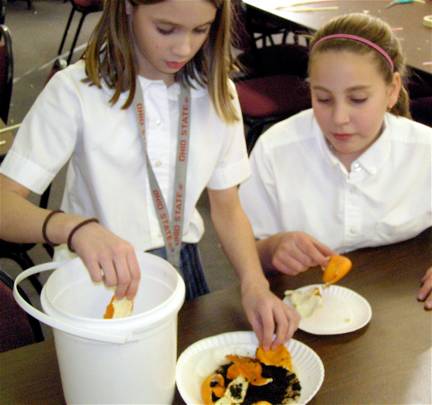
Collect kitchen scraps and leftovers in a container with a lid, like a plastic ice cream tub, and then add them to the composting area of your garden. I once told my mother that a lot of her cooking would make “good compost”. I’m not sure she appreciated the compliment.
What kind of “stuff” can be composted?
Many things that grow in the soil like grass, wood, fruits and vegetables are perfect for composting. These are what we call organic matter.
Good composting materials fall into two groups, the browns and the greens. The browns would be things like leaves, twigs, wood chips, or hay. The greens are things like vegetable scraps or grass clippings. To get a good end product from composting, it is best to have carbon rich materials like leaves, straw and woodchips along with nitrogen rich materials such as grass clippings and kitchen scraps. It is best to us both greens and browns.
Some things you might not have considered, like paper, lint from your clothes dryer, or even hair, make excellent composting materials. If you have goats, rabbits, horses, etc. the manure can add many needed nutrients.
You should avoid materials such as metal, plastic, glass or foods like meat or grease, which could attract unwanted animals.
To get a really good list of materials to add to your compost, and more detailed information, take a look at www.smartcenter.org/ovpm/composting/
Mixing it up:
The most important step after starting your compost area is to “mix things up” from time to time so air can reach the compost. Digging with a shovel or garden fork, or poking holes works fine. After a short time, you will notice changes in the material and more worms, insects, and other creatures moving in.
Composting involves a whole team of organisms that decompose or “break down” organic material into a rich, dark material called humus. (pronounced hyou-mus). Some of these workers are easy to see, like worms and insects. Others like bacteria and fungi are too small to see or are hidden in the soil, quietly taking apart the organic materials.
Our gardens bring us lots of healthy food and beautiful flowers. Composting is a way to give something back to the soil in our gardens. Another benefit for girls and boys who enjoy fishing, is a plentiful supply of fishing worms!
Words to look up: composting decompose humus soil fertilizer fungi organic mulch
Libby and Robert Strong and Richard Pollack work at the West Liberty State College SMART-Center: www.smartcenter.org For astronomy and other events: www.smartcenter.org/whatsup/