“Sounds Like Spring”
This time of the year, as we move from early spring toward summer is one of the most interesting for young scientists. Things are changing, and we can use all of our senses to make good observations. Have you noticed there are different smells in the air? When you wake up in the morning do you hear anything new or different?
One of the best ways we can gather information is by listening very carefully. If you hike in the woods or do nature walks with your family and friend, listen for the sounds all around you while you get some fun, healthy exercise. Try to hear the “quietest” sounds, like water flowing, a soft breeze through the leaves, or tiny insects buzzing around nearby flowers.
In a notebook, write the things you hear. Include information about what you saw, where you were, the time of day, temperature, etc. Scientists would consider this to be “recording data”, very important to good research!
The sounds of spring include natural sounds and man made sounds. They all share certain qualities. Sounds can be loud or quiet. They can sound “high” like a bird singing, or “low” like a dog growling. As you listen to sounds, notice how loud they are and whether the sound is high or low. Older students might know these qualities as amplitude and pitch, or frequency.
To explore some things that cause sounds to vary, we can try some fun sound experiments. Using ordinary plastic straws, we can make a simple “straw oboe” that will help us explore some properties of sound.
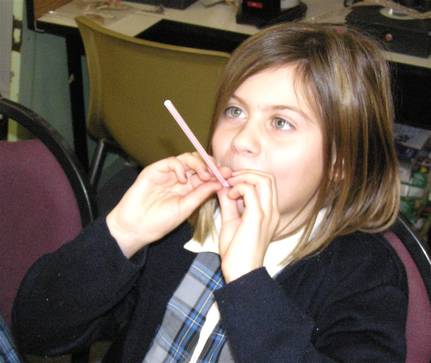
Isabella Rosso Third Grade, Corpus Christi Parish School
Materials you will need:
Plastic straws, scissors, and masking or regular tape.
Procedure:
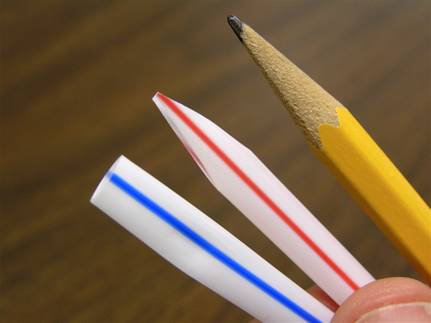
1. Take a regular or bendy plastic straw and flatten one end by squeezing with your fingers or gently biting on it.
2. Cut the edges to make a triangle shape on top. It should look like the pointy end of a pencil.
3. Make sure the end is inside your mouth and blow gently to make a buzzing sound. (This could really tickle!) What happens when you blow harder?
4. Experiment by cutting your straw shorter and shorter. How does the sound change?
5. Tape another straw to the end of your straw. How does the sound change?
How else could you change your basic “straw oboe”? Can you make finger holes like you find on a flute? Could you slide a large straw over your straw to make a trombone? Can you find other ways to affect the sound using your hands?
For information about family oriented science related
activities and Summer Camps co-sponsored by the SMART-Center, please check our
website smartcenter.org
12 part series “The Solar System Inside and Out”
ASTROLABE Astronomy Club meets on the third Wednesday evening of each month at 7:00 p.m. on the Second floor of the Warwood Center at 1610 Warwood Avenue, Wheeling and will host the 12 part monthly series “The Solar System Inside and Out”.
Radio Science News
To learn more about science, or even call in with a question, you can tune into “Radio Science News” on WVLY 1370 AM Saturday mornings from 11:00 a.m. to noon. “Radio Science News is hosted by Robert E. Strong and Richard Pollack, following “The Wild Side”, hosted by naturalist Dr. Scott Shalaway.
Science in Science Fiction Club:
The “Science in Science Fiction Club” meets on the second Wednesday evening of each month at 6:00 p.m. on the Second floor of the Warwood Center at 1610 Warwood Avenue, Wheeling. Free to the public, snacks and refreshments are provided as we watch and discuss the science in science fiction movies.
What’s Up?
Free Monthly StarWatches at Brooke Hills Park:
Free public StarWatches every third Friday evening of each month at 8:00 p.m. at Brooke Hills Park’s Cardinal Shelter will be led by members of the ASTROLABE Astronomy Club, staff of the WLSC SMART-Center, and the Near Earth Object Foundation.
Libby and Robert Strong and Richard Pollack work at the West Liberty State College SMART-Center and invite you to visit the SMART-Center website at www.smartcenter.org