Fall Into Science!
What
is your favorite color? If it is
yellow, orange, red, purple, brown, or even green you can enjoy it in the
autumn leaves. Just what causes
the leaves on your favorite maple tree to turn to brilliant colors in the
fall? One of the exciting things
in science is there are still things to discover and understand better. Leaves changing color in fall is an
example of how scientists don’t yet completely understand all that is going on
here! Maybe someday you can
explain it!
In the meantime, what we already know is that in the fall, many trees start to slow their growth and prepare for winter. With decreasing sunlight, the green pigment called chlorophyll isn’t needed and the tree stops making it. When the chlorophyll is gone other pigments can be seen that were in the leaf the whole time. These carotenoids create bright yellows and oranges. Reds and purples come from chemicals made by the leaf in autumn when conditions are just right. These chemicals are called anthocyanins. Not all trees make anthocyanins. Browns usually come from waste products as they build up in leaves. For more details on leaves changing color, visit our website www.smartcenter.org/ovpm/leafcolor
One
of the most enjoyable fall activities is to go “leaf peeping” with your
family. To find out when the peak
season for different regions of West Virginia specifically see one of our
favorite leaf color webpages:
http://www.wvforestry.com/fall_foliage.cfm?menucall=fallfoliage
For information about when the best time to go “leaf peeping” in Ohio and Pennsylvania see the links at www.smartcenter.org/ovpm/leafcolor
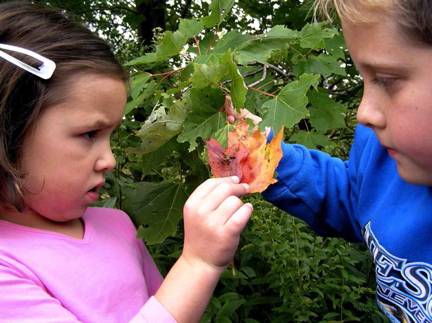
With a little practice you will be able to use leaf color as a way to help identify trees along with leaf shape, bark, other characteristics. The following photo shows two young scientists studying a red maple leaf.
Make a Leaf Collection
To make a fall leaf collection you will need the following items:
A: Old phone book and several heavy books
B: Poster board or used cereal boxes (please don’t just dump out the cereal)
C: Yarn and hole punch (optional)
D: Marker
E: Clear contact paper
F: Several different leaves
Procedure for the Leaf Collection Activity:
1) Collect several leaves from different trees.
2) Place the leaves between the pages of an old phone book (this helps the leaves to dry while keeping them flat) – this is called “pressing” the leaves.
3) Close the phone book and place it on a flat surface like a table top.
4) Place additional heavy books on top of the phone books.
5) Let the leaves dry in the phone book for a few days.
6) After a few days, check the leaves – if dry go on to step 7). If the leaves are still moist, wait a few days and check them again.
7) With the dry and pressed leaves, place each leaf on a piece of poster board (or cereal box) and cover with a piece of clear contact paper.
If you have identified your leaves, use the marker to write the leaf name and the date and place where you found the leaf. If you have not yet identified the leaves you found, check the following website for assistance: http://www.wvstateparks.com/Leaf_id.pdf
You can make your leaves into a booklet by using a hole punch to make a hole on the upper left corner of each page and connecting the pages with yarn. Be creative with your fall leaf colors.
Other family oriented science related activities
co-sponsored by the SMART-Center
12 part series “The Solar System Inside and Out”
ASTROLABE Astronomy Club meets on the third Wednesday evening of each month at 7:00 p.m. on the Second floor of the Warwood Center at 1610 Warwood Avenue, Wheeling and will host the 12 part monthly series “The Solar System Inside and Out”. The topic for October 18 is Near Earth Objects – present threats and future resources and will offer hands-on activities appropriate for all age groups. Snacks and refreshments are provided. The series is sponsored in part by the NASA West Virginia Space Grant Consortium. After the meeting, if the sky is clear, a free public StarWatch will be held in front of the Warwood Center.
If you want to learn more about science, you can tune into “Radio Science News” on WVLY 1370 AM, Saturday mornings from 11:00 a.m. to noon. “Radio Science News” immediately follows the two-hour nature program, “The Wild Side”, hosted by the regional naturalist Dr. Scott Shalaway. Robert E. Strong and Richard Pollack co-host “Radio Science News”, a local radio call-in program with a science theme.
Science in Science Fiction Club:
The “Science in Science Fiction Club” meets on the second Wednesday evening of each month at 6:00 p.m. on the Second floor of the Warwood Center at 1610 Warwood Avenue, Wheeling. Free to the public, snacks and refreshments are provided as we watch and discuss the science in science fiction movies. Check the website www.smartcenter.org for movie titles and information.
What’s Up?
Free Monthly StarWatches at Brooke Hills Park:
Free public StarWatches every third Friday evening of each month at 8:00 p.m. at Brooke Hills Park’s Cardinal Shelter will be led by members of the ASTROLABE Astronomy Club, staff of the WLSC SMART-Center, and the Near Earth Object Foundation.
Telescopes will be provided and the public is also invited to bring their telescopes to the StarWatch events. If the weather does not permit outdoor telescope viewing, the co-presenters will give an astronomy related interactive presentation for the whole family. The StarWatches are sponsored in part by the NASA West Virginia Space Grant Consortium. Please visit www.smartcenter.org/whatsup/ for up-to-date listing of astronomy and other events.
Libby and Robert Strong and Richard Pollack work at the West Liberty State College SMART-Center and invite you to visit the SMART-Center website at www.smartcenter.org