Nature’s Autumn Art
“I think that I shall never see
A poem lovely as a tree. ...” By Joyce Kilmer.
For those of us who live in a climate that has an autumnal season, the leaves of trees become particularly beautiful. Leaves are the solar powered food factories of trees. In fall the changing colors of leaves we see are the result of changes in temperature, amount of sunlight, and other factors. Leaves have pigments, or materials that have particular colors. These leaf pigments can be brown, orange, yellow, and even red. These pigments have been present all along in leaves are usually over shadowed by the green chemical called chlorophyll used in the tree food making process known as photosynthesis. Chlorophyll makes the leaves look green, but when autumn arrives the plant stops making new chlorophyll and the other pigments now become visible in the leaves.
What colors are found in the colorful fall leaves in your area? Do different kinds of trees have different leaf colors in the fall? Fall is a wonderful time to go for a walk with your parents to look at the fall leaf colors. Many families make outings and trips to see the beautiful colors the leaves turn in the fall. These outings are called “leaf-peeping”. For more information on when and where in your area would be best for a fall leaf-peeping trip see the website http://www.weather.com/activities/driving/fallfoliage/
A great art and science project with fall leaves is “leaf chromatography”. Chromatography is a scientific technique that is used to separate the various pigment colors that may be found mixed into a particular over all color you see. To find out which colors are found in your favorite autumn leaves, try the following activity. Make sure your parents or an adult helps you. This activity is adapted from Better Homes and Gardens, October 2005.
Leaf Chromatography Activity:
You will need:
1) leaves from different types of trees (not pine needles)
2) baby food jars with lids, one jar for each leaf sample
3) rubbing alcohol (enough to cover leaf pieces in each jar)
4) pen or pencil
5) scissors
6) plastic spoons
7) shallow pan (large enough to place all the jars in)
8) hot tap water
9) paper coffee filters (one for each jar)
10) masking tape - 2.5 cm (about an inch) for each jar
See October 2005 and 2006 Ohio Valley Parent Magazine SMART-Center articles to learn more about leaves at www.smartcenter.org
Procedure:
A) Pick several colorful leaves (including green) from different trees.
B) Tear each leaf into small pieces and place each piece into a separate jar.
C) Label the jar with the name of the tree (on line tree ID guide, bark, leaf, shape and size of tree).
D) Cover the leaf pieces in each jar with rubbing alcohol. Use a (plastic) spoon to crush leaf pieces into alcohol.
E) Loosely cover the jars with lids.
F) Place the baby food jars in the shallow pan and pour 2.5 cm (about an inch) of hot water into the bottom of the pan.
G) Leave the jars in the water for 30 minutes or until the alcohol in the jars starts to change color.
H) Swirl (not shake) each jar gently every five minutes until the alcohol becomes colored with the pigments from the leaf. Replace back into the hot water after each swirl.
I) Cut long, narrow strips 1 to 2 cm (0.4 to 0.8 inches) wide and at least 10 cm (4 inches) long from the coffee filters, one per jar.
J) Remove the jars from the water and take off the jar lids.
K) Place one end of the coffee filter strip into each jar until it touches the liquid and tape the opposite end of the strip to the jar edge.
L) Leave jars uncovered for 30-90 minutes.
M) Remove coffee filter paper strips and compare results.
How were your different samples’ results different? How were they similar?
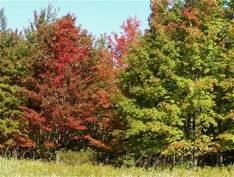
Fall colors, Gormania, WV (Photo by Robert E. Strong 2006)
Long Lasting Leaves
If you ever wanted to enjoy the wonderful fall colors all year long, try a second Nature’s Autumn Art Project.
You will need:
1) Various colors of leaves
2) Glycerin (found in drug stores)
3) Water
4) Shallow glass or plastic container with a lid (or you can use plastic wrap as a cover)
Procedure:
A) Collect a variety of leaves at their peak color and rinse them in cool water.
B) Mix 1 part glycerin and 2 parts hot water in the shallow container.
C) Place leaves in pan.
D) Push the leaves under the solution and cover completely.
E) Cover the container and place in a shaded area.
F) Check on the leaves every few days and replace solution if it begins to get clumpy.
G) When the leaves are evenly colored and flexible (this will take 2-3 weeks), remove from the glycerin and water solution and place on dry newspaper to dry them for one week.
After your beautiful fall leaves have become preserved, you can use them for many years in art projects at home and school.
Libby and Robert Strong and Richard Pollack work at the West Liberty State College SMART-Center and invite you to visit the SMART-Center website at www.smartcenter.org