By Libby and Robert Strong and Richard Pollack
Did you know that most of the food we eat is made possible by the action
of animals called pollinators? Without these beneficial animals
many of our favorite and most nutritious foods would not be available to
us. A variety of plants are dependent on pollinators because the
pollinator brings pollen to the flower that forms seeds that grow into new
plants.
Without pollinators, the world would be a lot less colorful and certainly
less tasty! Just a few of the tasty plant parts that come to
us courtesy of pollinators are apples (fruit), broccoli (flower), lettuce
(leaves), celery (stem), and carrots (root).
Many different animals such as insects—beetles, flies, wasps, ants, bees, and butterflies—along with birds and even some mammals carry pollen from one flower to another while they are gathering their own lunch of nectar, pollen, or other yummy plant products or parts. It is because of this moving around and gathering food that the pollen travels from flower to flower and plant to plant and results in the process of pollination.
To make a model of “insect pollination” you will need the following:
A: Permission from your parents – sometimes doing science experiments and activities is accompanied by small messes. Ask your parents first so they are ready to help in the fun and the cleanup.
B: An old toothbrush you are getting rid of.
C: A pinch (not your little brother or sister type of pinch) of Koolaid or other soft drink mix powder.
D: Two sheets of paper and some crayons.
Procedure:
Step 1: Draw a beautiful flower of the same kind on each sheet of paper. Pollen only pollinates a flower of the same kind that the pollen came from.
Step 2: Sprinkle a pinch of Koolaid or other soft drink mix powder onto the center of one of your flowers.
Step 3: Imagine that the bristle part of the head of your toothbrush
is a hungry insect.
Chow down on the delicious nectar at the center of the flower.
Insect dining sounds are acceptable.
Step 4: Notice what happens to the bristles of your toothbrush during your snack at the first flower.
Step 5: After a few seconds all the nectar is gone so you need to fly to the next flower to find more nectar. We will wait for you while you fly to the next flower.
Step 6: After feasting at the second flower with your toothbrush, notice what happened.
What you just did is called modeling a science event. Do you think this activity worked well for modeling the transfer of pollen from one flower to another by a pollinator? What would you do differently to make this pollination model even better?
One well-known category of pollinators is butterflies. During warm days in summer and early fall butterflies are quite common. What kinds of butterflies do you see in your yard? Try to identify the butterflies using a field guide or one of the websites we have listed for you at http://smartcenter.org/ovpm/butterflyid
Watch the plants in your yard for a week.
What kind of butterflies did you see visiting which plants? Draw pictures of your new butterfly friends and the plants they visit. Keep the drawings of the butterflies and the plants in a journal. Do some butterflies seem to prefer certain plants? Take a walk with your parents in a meadow or for a special treat, visit the Joan Stifel Corson Butterfly and Wildflower Gardens at the Schrader Environmental Nature Center at Oglebay Park . Over 130 species of butterflies have been documented visiting the flowers there.
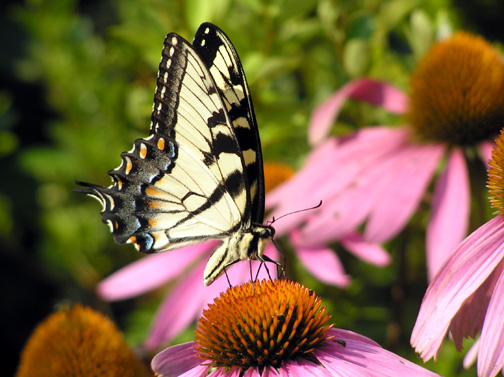
If you want to attract more butterflies to your yard, you can plant native wildflowers and other native plants. Some good choices include the purple coneflower (with a zebra swallowtail butterfly) in the photo below:
A favorite butterfly is the monarch butterfly.
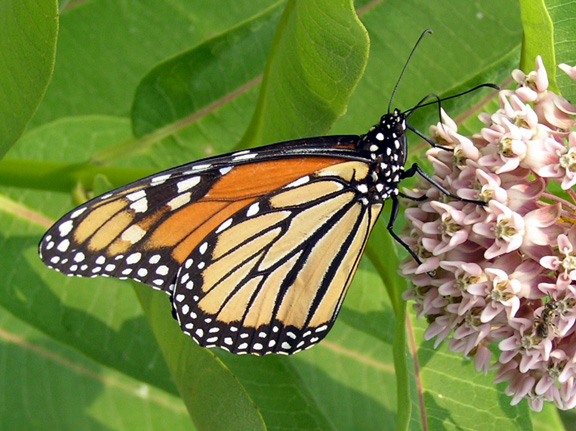
Monarch butterflies are well known for their annual long migration to and
from central Mexico. A common plant that attracts monarch butterflies
is milkweed. Monarch butterflies lay their eggs on milkweed plants.
Monarch butterfly caterpillars use milkweed as a host plant.
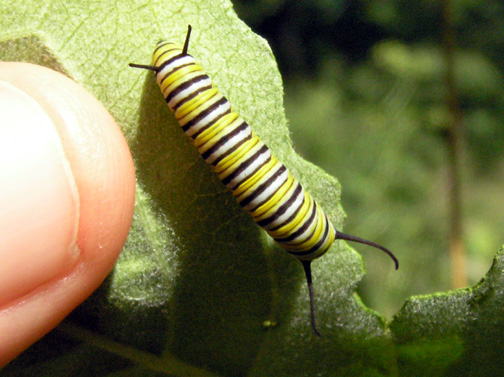
For more information on monarch butterflies check out our web site at http://smartcenter.org/ovpm/monarch
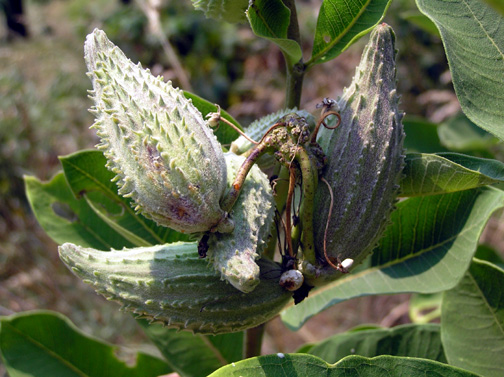
Milkweed seed pods are shown in the photo below:
Other plants that are native to the area and good for butterflies may be found listed at
http://smartcenter.org/ovpm/butterflyplants
Special thanks to Penny Miller, Oglebay Good Zoo for her assistance with this article.
What’s Up?
In the next couple of months, the planet Mars will look brighter and larger
than usual. This is because the red planet will be closer to
the earth than it usually is in its orbit around the sun. In
2003 Mars was closer to earth than it had been in over 60,000 years!
This year, it won’t be quite so close, but it will still be pretty cool.
On the evenings of October 28 and 29, 2005 the members of the local astronomy
club ASTROLABE, the Near Earth Object Foundation, and staff of the WLSC SMART-Center
will bring their telescopes to the Cardinal Shelter at Brooke Hills Park
for a MarsWatch event. While we gaze at Mars, the original 1952
movie version of The War of the Worlds will be playing. For more
information on the MarsWatch and other upcoming free astronomy events at
Brooke Hills Park, visit our website:
www.smartcenter.org/Whatsup
Libby and Robert Strong work at the West Liberty State College SMART-Center. Libby is the director of the West Virginia Handle On Science Program that brings hands-on science kits into the classrooms of K-6 grade public schools in the five counties of West Virginia’s Northern Panhandle. Robert is the Director of the WLSC SMART-Center, the hands-on science center of northern West Virginia. Richard serves as the Assistant Program Coordinator at the SMART-Center. Libby, Robert, and Richard invite you to visit the SMART-Center website at www.smartcenter.org